- Artist and The Machine 👾
- Posts
- Adobe’s New Era
Adobe’s New Era
Sponsored post: Artists will shape the tools, as the tools shape the work.
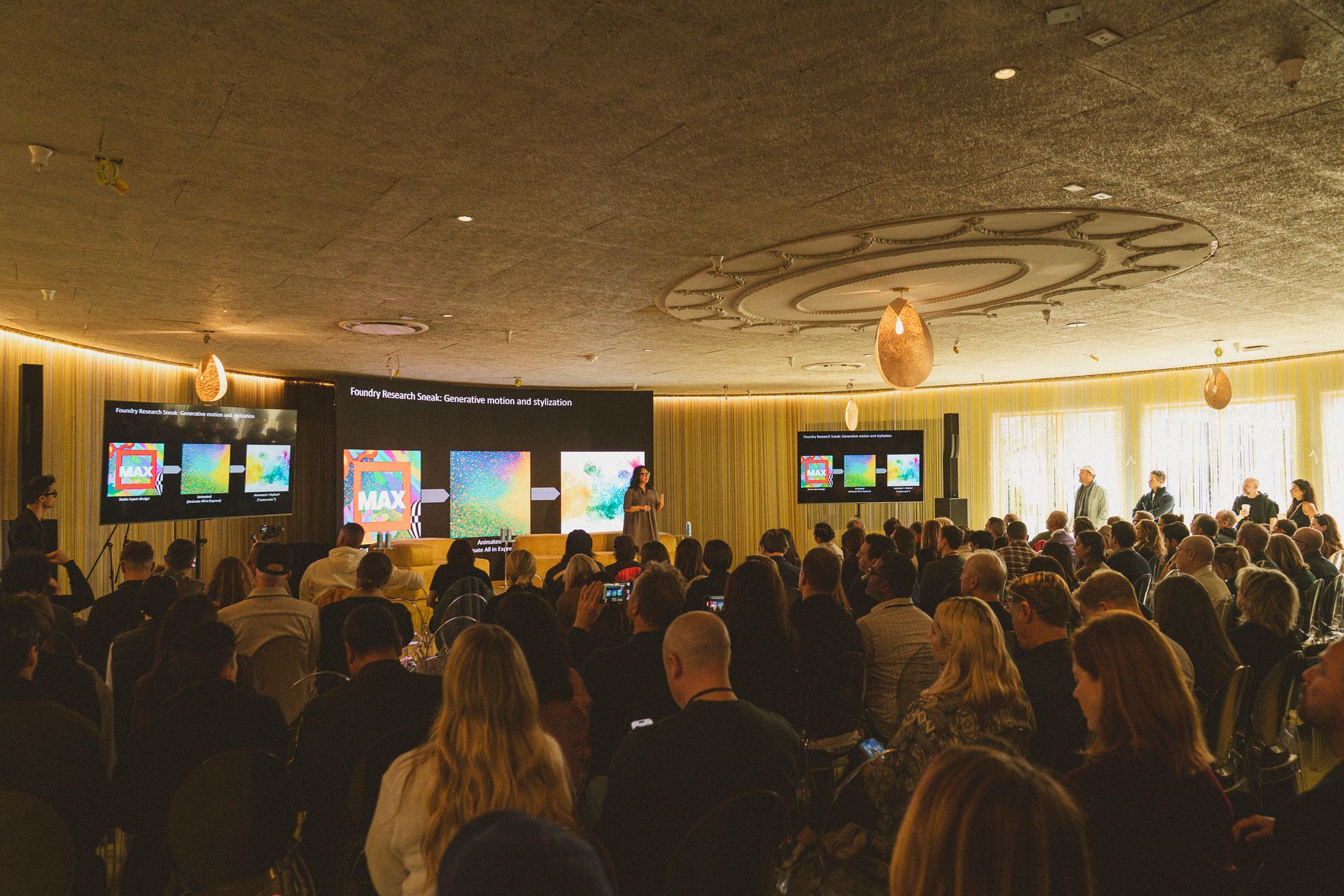
Hannah Elsakr presents at Artist and the Machine’s LA Summit
At Artist and the Machine’s LA Summit a couple of weeks ago, Hannah Elsakr from Adobe offered a view from the creative frontline. It was not just a preview of where creative technology is going, but an exploration of how new communities and creative practices are forming. She described a frontier where brands move alongside communities, where artists chart new territories at speed, and where raw ideas leap almost instantly into their own visual universes.
Elsakr identified a new age where creativity is not bound by time and production constraints. While these unlimited possibilities can be daunting, they also raise an important question: when the time between ideation and production is condensed, how do you ensure you're creating something meaningful?
This is the challenge Adobe is designing for: not simply accelerating creation, but supporting creators as they build worlds where audiences and customers can actively participate. These are spaces designed to invite fans in as collaborators rather than passive consumers while maintaining brand integrity.
Adobe provides the creative scaffolding that enables businesses to build comprehensive brand universes around their intellectual property, complete with the guardrails that keep these worlds coherent while being responsive to the fast-changing needs of customers or fans.
These participatory worlds fundamentally reimagine what fandom means. Rather than simply consuming brand content, audiences can now shape it. Elsakr described Gatorade as a partner that was quick to test these new possibilities. They recently invited fans to customize their own water bottles through AI-powered tools, it wasn't just creating a personalized product, it was inviting fans to play with brand IP. Adobe's tools provided creative guardrails that ensured fan designs aligned with brand identity while giving its community freedom to interact. Fans could design personalized bottles that reflected their own style and identity, turning a mass-market product into something uniquely theirs while staying within the Gatorade universe. This balance between openness and protection is what makes these participatory brand worlds viable at scale, transforming spectators into co-creators.
AI is another tectonic shift, and we have to figure out how to uplift craft with it.
We have seen these sorts of shifts before. When Adobe introduced Photoshop in 1990, the art world braced for disruption. Adobe responded by inviting David Hockney to demonstrate how digital tools could expand fine art's vocabulary. Today, "Photoshop" is a verb, absorbed into the grammar of creativity. New tools spark debate, then become indispensable as artists discover what they can do with them.
The question now is not whether AI will transform creative work; it already has. The question is how artists, marketers, and storytellers will shape that transformation. In a culture overloaded with content, the most durable brands are creating content that resonates emotionally and invites audiences to participate.
This is what marketers mean when they talk about “world-building”: they’re creating comprehensive brand universes, not just individual campaigns or assets, but interconnected ecosystems of visual elements, narratives, and experiences that audiences can explore and contribute to.
It's the difference between launching a product and creating a space people want to inhabit. Resonant worlds require ecosystems, not single assets. Tens of thousands of components, from 3D models and vectors to audio, images, and video, must interlock into coherent, living systems.

This all requires infrastructure. Adobe Firefly Foundry provides it, enabling businesses to work directly with Adobe and create tailored generative AI models that are unique to their brand. Trained on entire catalogs of your brand's existing IP, these proprietary Adobe Firefly Foundry models are deeply tuned and can be built on top of commercially safe Adobe Firefly models.
If you want to be an effective brand, more is not more. Break through, redefine fandom, and let consumers drive.
With that foundation, the most exciting work is already emerging. Artists are discovering new expressive pathways. Brands are deepening their connections with audiences. For more than thirty years, Adobe has shaped creative technology. Firefly and Foundry mark that shift: tools that don't just support vision, but amplify and expand it into entire personalized universes.
Remember to follow us on Instagram and LinkedIn as we get closer to our AI & Creativity Summit in New York in 2026:
Til next time,
Artist and the Machine team.
ARTIST AND THE MACHINE is a free newsletter featuring the latest in AI x culture. Subscribe so you never miss an issue, and if you liked it, share with 1-2 friends.
xx
